Monarch Airlines: The Rise and Fall of a British Aviation Icon
By Michael Sorsky
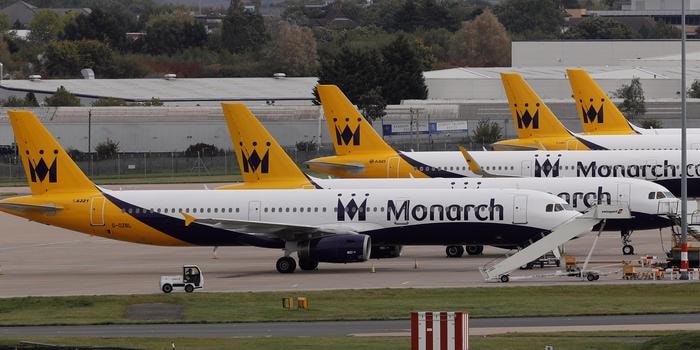
For fifty years, Monarch's gold crown and sunshine-yellow livery were a familiar sight at British airports. From Luton to Lanzarote, from Gatwick to Goa, the airline carried generations of British holidaymakers to the sun. Then, on 2 October 2017, it was all over.
Founded
5 June 1967
Home base
London Luton Airport
Peak fleet
40+ aircraft
Peak passengers
7 million per year
Ceased trading
2 October 2017
Stranded passengers
110,000
Born in the Package Holiday Boom
Monarch Airlines was founded on 5 June 1967 by the Mantegazza family — Swiss hoteliers who spotted an opportunity in Britain's rapidly growing appetite for affordable foreign holidays. Operating out of Luton Airport, the airline launched with a single Bristol Britannia turboprop, flying package tourists to the Mediterranean resorts that were transforming the British summer. The timing was perfect. The late 1960s saw an explosion in charter flying, as working-class families discovered that Spain, Greece, and the Canary Islands were within financial reach for the first time. Monarch was there from the very beginning, and Luton — then a modest regional airport — became its spiritual home for the next five decades.
Decades of Growth and the Jet Age
Through the 1970s and 1980s, Monarch grew steadily, transitioning from turboprops to jets and expanding its fleet with Boeing 720s and 737s. The airline built a reputation for reliability and value that set it apart from some of its more chaotic charter competitors. By the 1990s, Monarch had added Gatwick as a second major base and was operating wide-body Boeing 757s and 767s on longer leisure routes to the Caribbean, the Maldives, and the United States. The airline also developed a significant scheduled service operation alongside its charter roots, blurring the line between the two models in a way that would later prove commercially complicated.
The Golden Years: 2000s Expansion
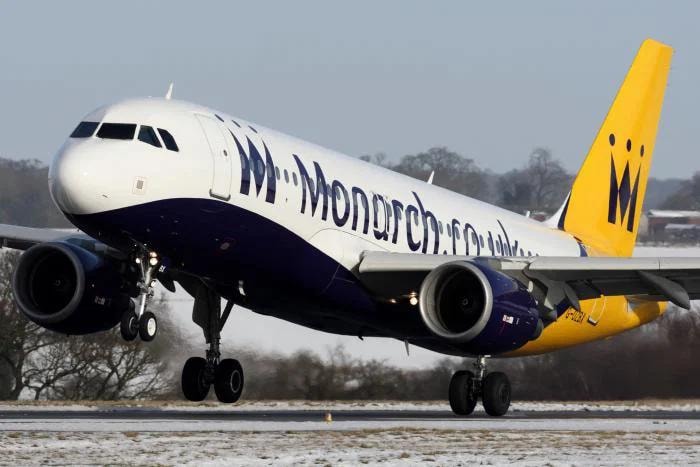
The early 2000s represented Monarch at its peak. The airline carried over seven million passengers a year, operated a fleet of more than forty aircraft, and had established bases at Birmingham, Manchester, and Leeds Bradford in addition to its Luton and Gatwick heartlands. Its Airbus A320 family fleet was modern and efficient. Monarch Holidays, its tour operating arm, was one of Britain's largest package holiday companies. The airline even launched Monarch Engineering, a maintenance division that serviced third-party carriers. For a brief, glorious period, Monarch looked like a genuine challenger to the established order of British aviation.
The Perfect Storm: Low-Cost Competition and Geopolitical Shocks
The seeds of Monarch's destruction were sown by forces largely beyond its control. The rise of Ryanair and easyJet fundamentally disrupted the economics of short-haul leisure flying, squeezing the margins on which charter airlines had always depended. Monarch's response — pivoting towards a hybrid scheduled and charter model — made strategic sense but required enormous capital investment at precisely the wrong moment. Then came a series of devastating geopolitical shocks. The Arab Spring of 2011, the Tunisian beach massacre of 2015, the Turkish coup attempt of 2016, and the ongoing instability in Egypt collectively wiped out several of Monarch's most profitable routes almost overnight. Passengers who had booked Sharm el-Sheikh or Enfidha found themselves rerouted to Spain and Portugal, flooding a market already saturated by competitors.
“For millions of Britons, the sight of that gold crown on a yellow tail will forever mean the beginning of a holiday.”
The End: 2 October 2017
By the summer of 2017, Monarch was burning through cash at an alarming rate. The Civil Aviation Authority had quietly been monitoring the airline's financial position for months. In the early hours of Monday, 2 October 2017, the CAA announced that Monarch had ceased trading with immediate effect. Around 110,000 passengers were stranded abroad. What followed was the largest peacetime repatriation in British history — a two-week operation involving 750 charter flights arranged by the CAA at a cost of approximately £60 million to the British taxpayer. Some 300,000 future bookings were cancelled. Around 2,100 staff lost their jobs. The crown had fallen.
A Legacy Written in Sunshine
Monarch's collapse sent shockwaves through the British travel industry and prompted a long-overdue debate about the adequacy of consumer protection for airline passengers. The ATOL scheme, which protects package holiday customers, covered many Monarch travellers — but those who had booked flights only found themselves with far weaker protections. The airline's story is, in many ways, the story of British aviation itself: born in the optimism of the postwar consumer boom, shaped by the jet age, buffeted by geopolitics and low-cost disruption, and ultimately undone by a combination of bad luck and structural change. For millions of Britons, the sight of that gold crown on a yellow tail will forever mean the beginning of a holiday. That is not a bad legacy for any airline.